Overview
Hi-Lo (also written Hi-Lo or High-Low) is a level-one balanced counting system. “Level one” means every card is tagged with only −1, 0, or +1 — never ±2 or fractions. “Balanced” means that if you count through an entire deck (or shoe) without error, the running count finishes at zero.
That balance property is powerful: it lets you convert the running count into a true count (count per remaining deck), which normalizes the advantage across single-deck, double-deck, and multi-deck shoes. Almost every modern training program and casino-simulation study uses Hi-Lo as the baseline comparison system.
Historically, the core idea descends from Edward Thorp’s work in the 1960s and was refined into the simple high-card / low-card dichotomy that players use today. Writers such as Stanford Wong popularized practical Hi-Lo procedures for casino conditions: how to size bets, when to take insurance, and how to “Wong in” (enter a table only when the count is favorable).
Approximate efficiency figures commonly cited for Hi-Lo; exact values depend on rules and simulation methodology. Use them comparatively, not as guarantees.
Study charts
Use these as a drill sheet. Numbers are common multi-deck Hi-Lo study values — not a casino guarantee.
Tag values
Every card you see gets a value. You do not need to remember suits — only ranks. The intuition is simple: low cards help the dealer more when removed (they “bust-proof” stiff hands), so when lows leave the shoe the remaining cards are richer in tens and aces for the player. High cards help the player (more blackjacks, better double-downs, dealer busts more often), so when highs leave, the shoe gets worse for you.
| Cards | Tag | Meaning |
|---|---|---|
| 2, 3, 4, 5, 6 | +1 | Low cards — good when removed |
| 7, 8, 9 | 0 | Neutral — ignore them |
| 10, J, Q, K, A | −1 | High cards — bad when removed |
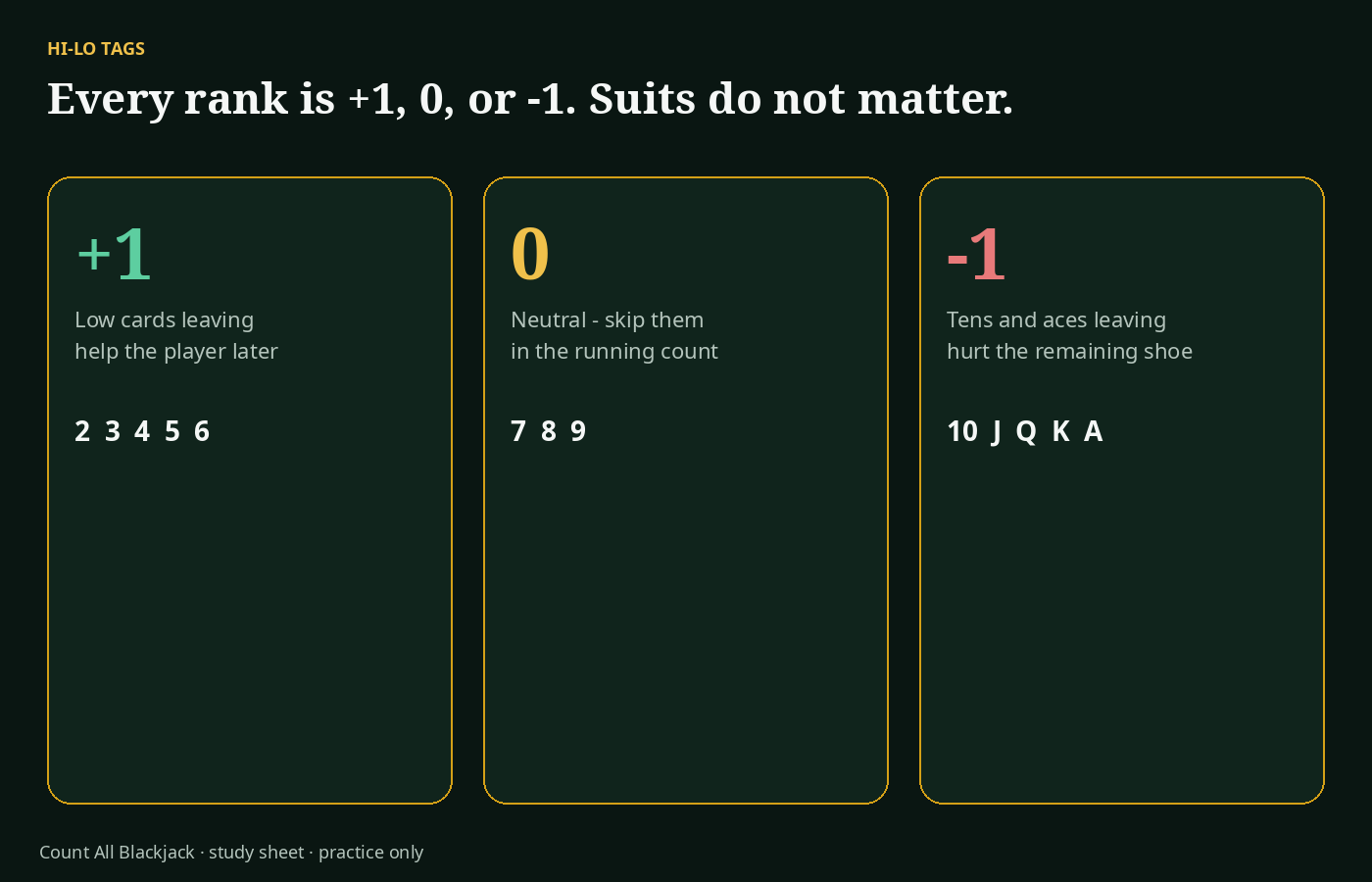
Think “small cards +1, face cards and aces −1, middle cards nothing.” Count a full deck offline until you always finish at 0 — that single drill proves your tags are solid.
Running count
The running count (RC) starts at 0 after a shuffle (for a balanced system). As each card is exposed — player hands, dealer upcard, hole card when revealed, burned cards if visible — you add its tag to the running total. You keep this number continuously, not just once per round.
A rising RC means more low cards have been seen than high cards → the remaining shoe is rich in tens and aces → player edge improves. A falling RC means the opposite: high cards are depleted and you should bet small or leave.
What to count
- All player cards that are face-up.
- Dealer’s upcard immediately.
- Dealer’s hole card when it is flipped (after players finish, or immediately on blackjack checks depending on procedure).
- Any cards dealt face-up in multi-hand or side spots you can clearly see.
You do not need the value of face-down cards you never see. Perfect information is not required — card counting estimates composition from the cards that are exposed.
True count
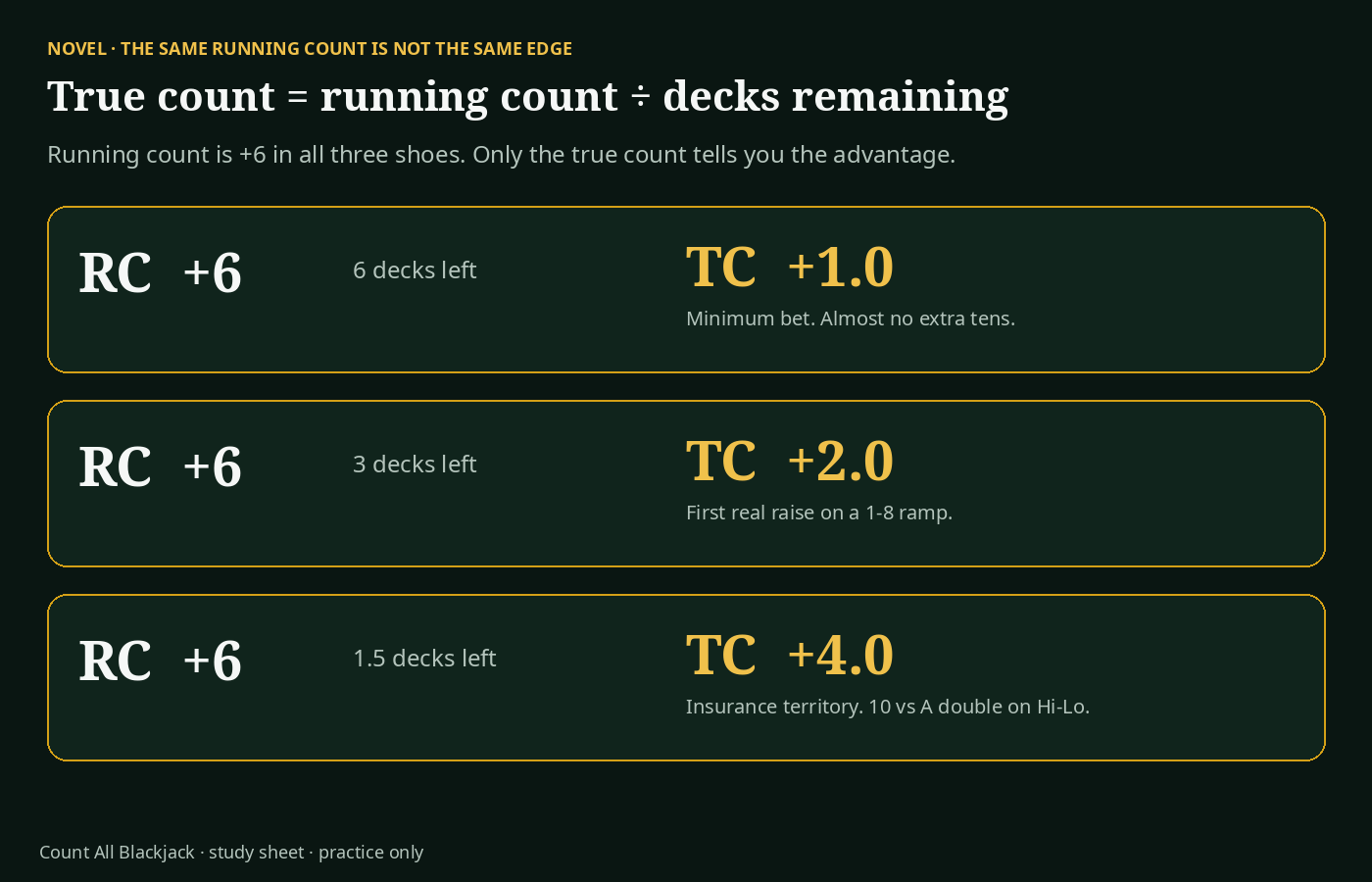
In multi-deck games, a running count of +6 with six decks still in the shoe is weak; the same +6 with only two decks left is strong. True count (TC) fixes this:
Round toward zero or use a consistent house rule (many players floor or round to nearest half-deck). Consistency matters more than the exact rounding convention.
Estimating decks remaining
Glance at the discard tray. If a six-deck shoe started full and roughly two decks are discarded, about four decks remain. With practice you estimate to the half-deck. Error here is a major source of real-world disadvantage versus perfect simulation — train it deliberately.
Examples
- RC = +8, decks left ≈ 4 → TC ≈ +2
- RC = +8, decks left ≈ 2 → TC ≈ +4
- RC = −6, decks left ≈ 3 → TC ≈ −2
Bet size and many strategy deviations key off true count, not raw running count (except in single-deck games where RC and TC are nearly the same early in the deck).
Why it works
Blackjack is not an independent trial like roulette. Cards are dealt without replacement until a shuffle. Removing cards changes the probabilities of:
- Player blackjack (3:2 or 6:5 payouts make ten+ace especially valuable)
- Successful double-downs (more tens improve many doubles)
- Dealer busts on stiff upcards (2–6) when the shoe is ten-rich
- Insurance (pure ten-density proposition)
Hi-Lo’s tags are a compact statistic for “how ten/ace-rich is the remainder?” When TC is high enough, the player’s expected value can flip from slightly negative (the house edge under basic strategy) to slightly positive — enough that larger bets in those moments can overcome smaller bets when the shoe is cold.
Efficiency metrics
Three classic metrics compare counting systems:
- Betting correlation (BC) — how well the count tracks advantage for bet sizing. Hi-Lo scores very high (~0.97).
- Playing efficiency (PE) — how well it guides insurance and strategy deviations. Hi-Lo is moderate (~0.51); specialized systems score higher.
- Insurance correlation (IC) — alignment with ten density for insurance decisions (~0.76 for Hi-Lo).
For most recreational and semi-serious players, Hi-Lo’s excellent BC is the priority: most of the gain from counting comes from betting more when you have the edge, not from the smaller gains of perfect index plays. Advanced systems improve PE at the cost of mental load.
Betting strategy
A betting ramp maps true count to unit size. Exact numbers depend on bankroll, risk of ruin, and table minimum/maximum. Conceptually:
| True count | Typical approach |
|---|---|
| TC ≤ +1 | Minimum bet (or leave / sit out if possible) |
| TC +2 | Raise to a few units — edge emerging |
| TC +3 to +4 | Medium–high bets |
| TC +5 and up | Top of ramp (subject to heat and max bet) |
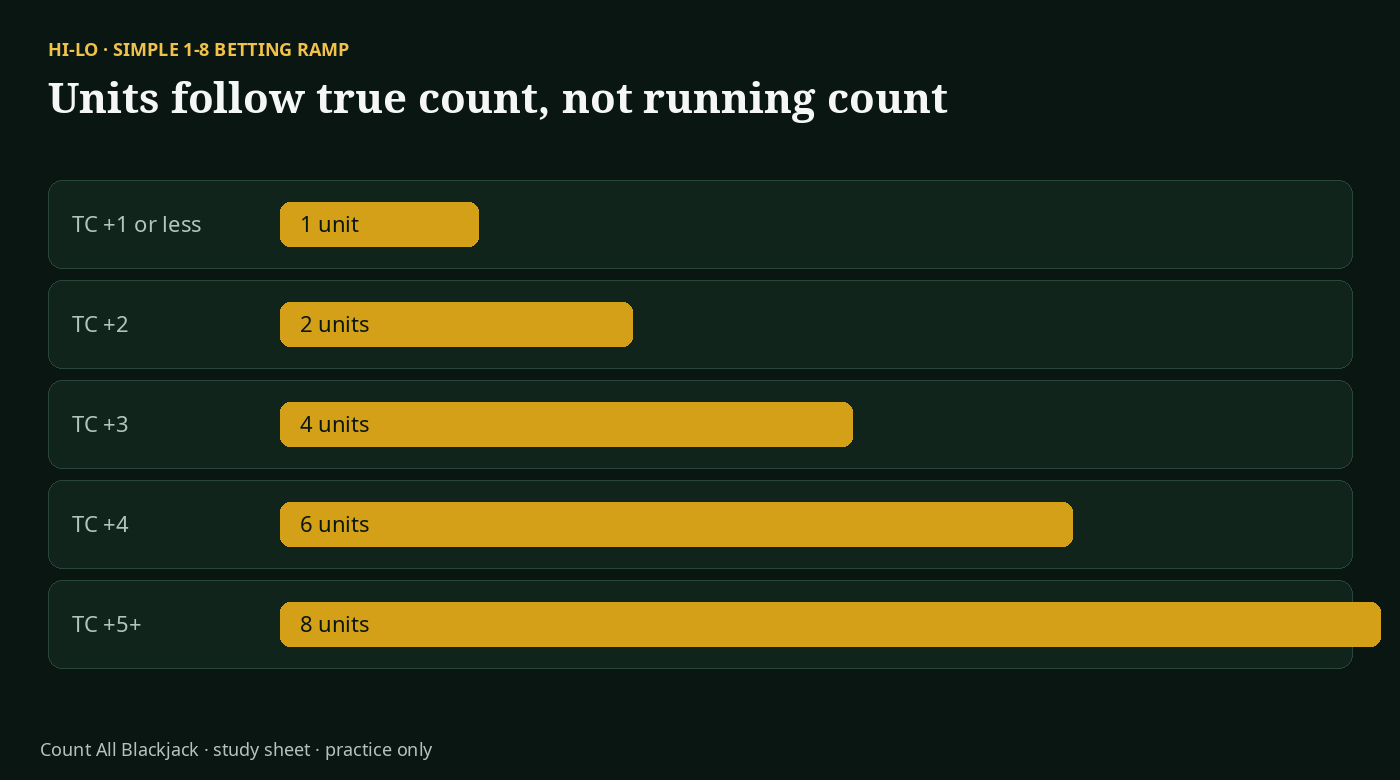
Aggressive ramps increase variance and casino scrutiny. Educational practice should include spread discipline and “camouflage” awareness — even perfect math fails if you cannot play the game.
Playing decisions & index plays
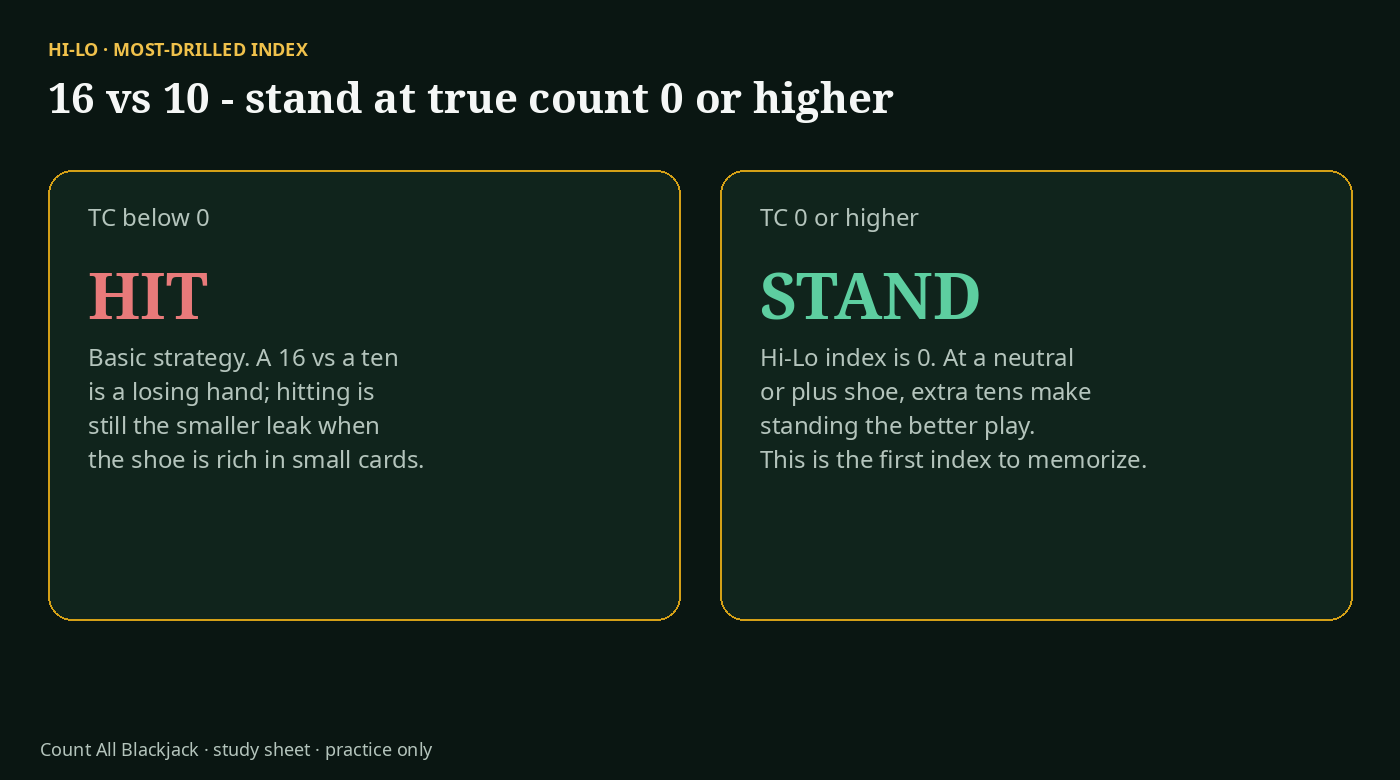
Basic strategy is still the foundation. Counting adds index plays (Illustrious 18 / Fab 4 style lists are often paired with Hi-Lo): situations where you deviate when the true count crosses a threshold.
High-value Hi-Lo style deviations (illustrative)
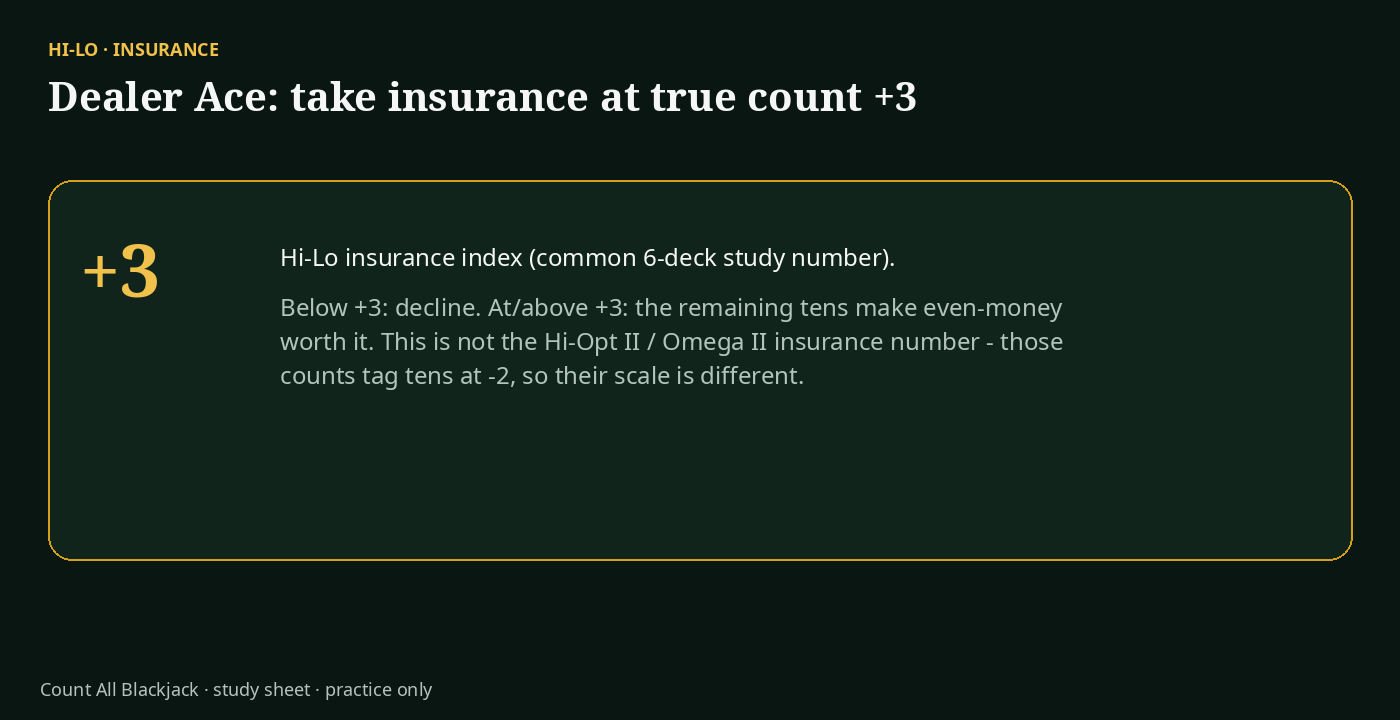
- Insurance — take when TC is high enough (often cited near +3 in multi-deck; confirm for your rule set).
- 16 vs 10 — stand at higher counts instead of hitting.
- 15 vs 10 — stand at sufficiently high TC.
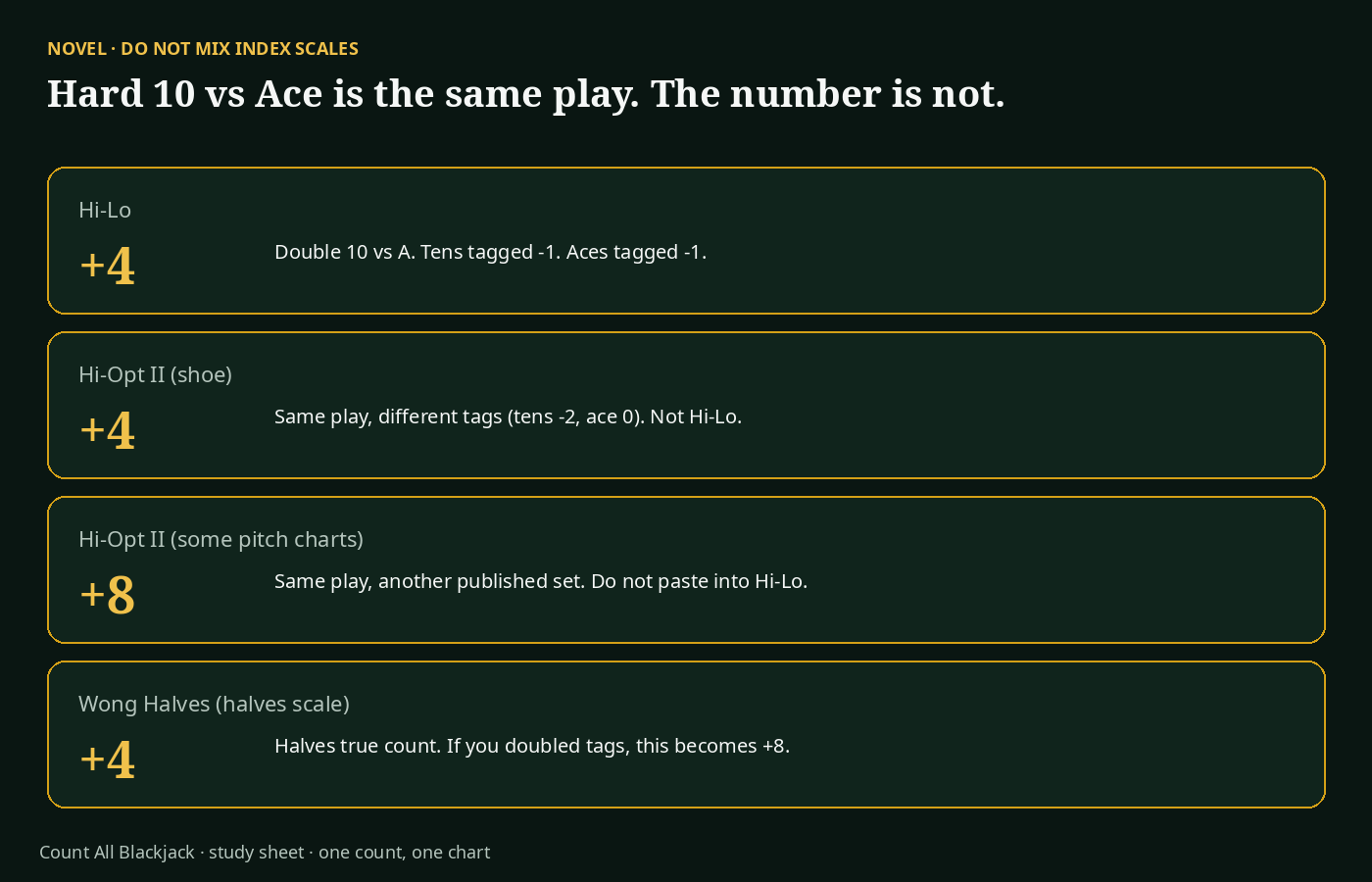
- 10 vs 10 / 10 vs A — double more aggressively at high TC; avoid at low TC.
- 12 vs 3, 12 vs 2 — stand earlier when counts rise (dealer more likely to bust).
- Late surrender indices when the game offers it.
Full index tables fill pages and depend on decks and rules (H17 vs S17, DAS, surrender, etc.). Train basic strategy to automatic first, then add the most valuable indices one cluster at a time.
Insurance in depth
Insurance is a side bet that the dealer has blackjack. It pays 2:1 and is actuarially poor with a full shoe — but it becomes correct when ten-density is high enough. Because Hi-Lo tracks tens and aces together (aces also −1), it is a good but not perfect insurance predictor; systems with separate ace side counts can refine this further.
In practice, many Hi-Lo players use a simple true-count cutoff for insurance and ignore finer adjustments until their primary count is flawless.
Worked example
Six-deck shoe. Start of a round: RC = +4, discard tray shows ~2 decks used → ~4 decks left → TC ≈ +1. Bet stays low.
Cards seen this round:
Tags: +1, +1, −1, +1, +1, −1, 0, +1 → round delta = +3
At TC +2 you may begin raising bets slightly depending on your ramp. Continue updating every round.
Pros & cons
Strengths
- Easiest high-power balanced system to learn
- Excellent betting correlation
- Huge training ecosystem and literature
- Works across 1–8 decks with true count
- Enough PE for the most valuable indices
Tradeoffs
- Playing efficiency only average
- Requires true-count division (mental load)
- Aces bundled with tens (not ideal for all side bets)
- Advanced systems extract slightly more EV
Training plan
- Week 1 — Tags only. Drill flash cards until each rank maps instantly. Count down a single deck to 0 in under 30–25 seconds.
- Week 2 — Running count. Deal hands face-up; keep RC without pausing. Aim for zero errors over 2–3 shoes.
- Week 3 — True count. Estimate discard tray every round; convert RC → TC aloud, then silently.
- Week 4 — Betting ramp. Assign chips to TC; practice smooth spreads without telegraphing.
- Ongoing — Indices. Add insurance first, then Illustrious-18 style plays. Re-test full-deck accuracy weekly.
Performance targets used by many trainers: near-100% tag accuracy, single-deck count-down under ~20–25 seconds, and multi-deck simulation accuracy above ~98% before considering live play.
Common mistakes
- Skipping true count in multi-deck games — RC alone mis-sizes bets badly.
- Miscounting aces as zero — in Hi-Lo aces are −1, not neutral.
- Updating only once per round — update as cards appear so mid-round decisions (insurance, doubles) use current info.
- Ignoring shuffle points — know pen (how deep the shoe goes) and reset RC only on shuffle.
- Chasing losses with the count — TC dictates bet size; emotion does not.
- Over-focusing on rare indices before the running count is automatic.
New to the tags? Start with how to count cards in blackjack, then running count vs true count and a four-week home practice plan. Comparing beginner systems? Hi-Lo vs KO. Odds and bankroll context: house edge, variance, betting systems vs a count. Once Hi-Lo is automatic under distraction, try KO (no true count) or Hi-Opt I.